AI in Semiconductor Manufacturing for Defect Detection
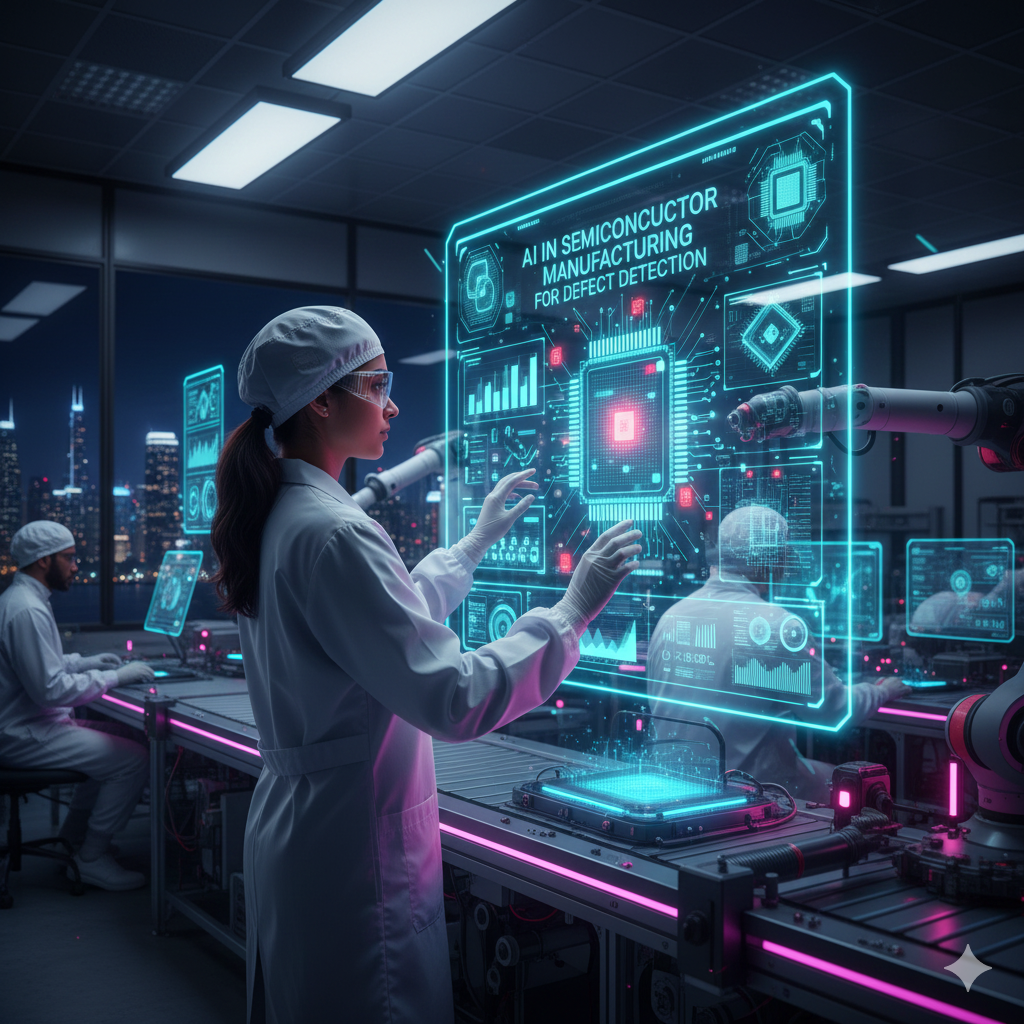
AI in Semiconductor Manufacturing for Defect Detection
The fabrication of semiconductors is one of the businesses that requires the highest level of precision. Even minute flaws can result in significant functional failures or a decrease in product yield. Traditional methods of inspection frequently rely on manual visual examination or limited automated systems, both of which can be slow, unreliable, and prone to oversight. Through the utilization of machine learning algorithms, computer vision, and real-time data analysis, artificial intelligence (AI) is revolutionizing the process of defect detection in semiconductor manufacture. This is accomplished by identifying abnormalities with an unparalleled level of speed and precision. This ensures that the goods are of a higher quality, that the efficiency of the manufacturing processes is increased, and that there is less waste.
Immediate Identification of Deficiencies
Real-time inspection of wafers, chips, and integrated circuits during production is made possible by technologies that are powered by artificial intelligence. In order to detect flaws such as fractures, contamination, or lithography errors, high-resolution cameras and sensors are used to collect precise images of semiconductor surfaces. Artificial intelligence algorithms are then used to evaluate certain patterns. The use of real-time detection enables manufacturers to fix problems promptly, thereby avoiding defective items from moving forward along the manufacturing line and lowering the percentage of products that require rework or scrap.
The Application of Machine Learning to Recognize Patterns
During the manufacturing process of semiconductors, machine learning models are trained using huge datasets that contain both known flaws and normal patterns. These computer programs are able to identify minute differences that human inspectors would not even notice even if they try. Over the course of time, artificial intelligence systems continuously increase their accuracy by gaining knowledge from new types of defects and changes in manufacturing. Even if semiconductor designs are becoming more complicated and feature sizes are decreasing, this adaptive learning mechanism guarantees that detection performance will remain consistent.
Optimization of Processes Through the Use of Predictive Analytics
Not only is artificial intelligence capable of detecting faults, but it can also determine the underlying causes of such problems by studying relationships between production factors and detected anomalies. Data from lithography, etching, doping, and chemical-mechanical polishing processes are processed using machine learning algorithms in order to identify process variations that may result in defects. The use of predictive analytics enables engineers to make proactive adjustments to the settings of machines, the inputs of materials, or the conditions of the environment, thereby reducing the occurrence of defects before they have an impact on yield.
Increasing both the yield and the efficiency of production
The reduction of flaws directly enhances manufacturing yield, which is essential in the production of semiconductors because of the high prices of both the materials and the processes them go through. Defect detection that is based on artificial intelligence enables manufacturers to swiftly discover and address inefficiencies, hence minimizing waste and increasing the number of functioning chips that can be produced from a wafer. Through the simplification of inspection procedures and the reduction of the amount of physical intervention, artificial intelligence not only speeds up production timelines but also improves overall operational efficiency.
Combining with Production Lines That Are Fully Automated
Defect detection that is driven by artificial intelligence can be seamlessly integrated with automated semiconductor production lines. Automated systems have the ability to remove or divert damaged wafers, modify processing parameters, or trigger maintenance alerts for specific pieces of equipment; these capabilities are activated when flaws are discovered. This integration guarantees that the production process is cohesive and self-regulating, which allows it to maintain high-quality standards while limiting the amount of human error that occurs.
In order to achieve continuous improvement, advanced analytics
Artificial intelligence systems gather and analyze massive volumes of inspection and operational data, thereby generating insights that can be put into action for the purpose of continuously improving processes. Engineers are able to monitor the progression of defects over time, assess the operation of equipment, and ensure that production workflows are optimized. Continuous learning and feedback loops make it possible for manufacturing facilities to improve their processes, adjust to emerging technology, and keep the quality of their products consistent even when they are producing large quantities.
Bringing Down the Costs of Operations and Cutting Down on Waste
Material waste, rework costs, and energy usage are all greatly reduced thanks to artificial intelligence’s ability to detect errors at an early stage and avoid the creation of faulty chips. The reduction of defective outputs in semiconductor fabrication plants not only helps to boost profitability but also contributes to the advancement of sustainability initiatives by lowering the amount of resources consumed and the degree of environmental effect.
Providing Assistance to Developments in Semiconductor Technologies
Traditional inspection methods are having difficulty keeping up with the rapid evolution of semiconductor devices, which are characterized by decreasing node sizes and more complicated topologies. The scalability and precision that are necessary for next-generation chips, such as improved processors, memory modules, and microelectromechanical systems (MEMS), can be achieved through the presence of defect detection that is powered by artificial intelligence. With the help of artificial intelligence, even the most sophisticated designs may be created to the greatest possible manufacturing standards.
Through the implementation of real-time monitoring, predictive analytics, and adaptive process optimization, artificial intelligence in semiconductor production is revolutionizing the process of defect detection. Yield, efficiency, and product quality are all improved as a result of its capacity to detect tiny faults, investigate the underlying reasons of those errors, and connect with automated production pipelines. In the current manufacturing industry, artificial intelligence-powered inspection systems will continue to be vital for ensuring the reliability and high performance of devices while simultaneously decreasing costs and waste. This is because semiconductor designs are continuing to progress and production complexity is increasing.