Troubleshooting Discrepancies Between Google Analytics 4 and Shopify Traffic Reports
Troubleshooting Discrepancies Between Google Analytics 4 and Shopify Traffic Reports
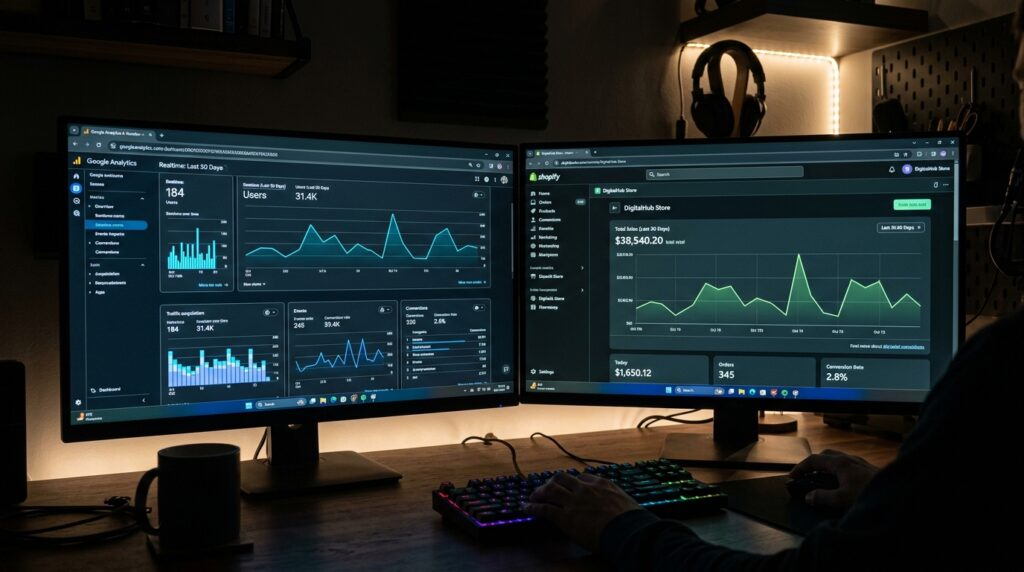
The disparities that exist between the traffic data generated by Google Analytics 4 and Shopify may lead to misunderstanding and have an effect on the decision-making process for digital marketers and owners of eCommerce stores. Both systems have distinct methods for tracking user activity, which results in various metrics such as the number of sessions, users, and conversions, among other things. Even though these variances are rather typical, they often give rise to worries over the quality of data and the success of campaigns. When it comes to measuring shop activity, Google Analytics 4 use an event-based monitoring mechanism, while Shopify depends on its own internal tracking system. Even when monitoring the same visitors, these fundamentally distinct approaches might generate findings that are inconsistent because of their differences. For the purpose of appropriately evaluating data and optimising marketing tactics, it is vital to have a solid understanding of the reasons behind these differences. Businesses run the risk of making incorrect assumptions about the sources of traffic and the behaviour of customers if they do not do enough analysis. In order to achieve greater alignment across platforms, it is necessary to identify the fundamental reasons. This guarantees that the insights are more credible and that the performance tracking is better. The majority of discrepancies may be properly resolved with the assistance of a methodical approach to troubleshooting.
A Comprehensive Understanding of the Variations in Tracking Methodologies
The event-based architecture that Google Analytics 4 uses to monitor particular user activities, such as page views, clicks, and conversions, is the basis for its operation. Shopify, on the other hand, is concerned with tracking sessions and customer activity based on its own internal logic that is connected to the environment of the shop. The disparity in tracking frameworks is one of the key factors that contributes to the existence of data inconsistencies. GA4 is responsible for recording events once a tracking tag is activated, while Shopify may monitor visits depending on the data that is stored on the server. In consequence of this, the same user activity could be recorded in a different manner on multiple platforms. As an example, a single session in Shopify might potentially produce many events in Gallery 4. When these methodological discrepancies are understood, it becomes easier to understand why statistics almost never match every single time. The fact that each platform should be treated as a distinct data source with its own logic is of utmost importance.
The Influence of Cookie Consent and Setting Privacy Preferences
There are major implications for the manner in which data is acquired in Google Analytics 4 due to privacy legislation and cookie consent methods. In the event that users choose to deny tracking cookies, GA4 may fail to capture their activity, resulting in traffic that is not adequately reported. In spite of this, Shopify may still be able to record certain interactions by using server-side tracking. A void is created between the two datasets as a result of this. In addition, privacy protections that are native to the browser may completely prevent GA4 tracking scripts from running. This kind of behaviour is particularly prevalent on mobile devices and browsers that prioritise privacy. In comparison to Shopify, GA4 often displays lesser traffic counts as a consequence of this. In order to properly analyse disparities, it is essential to have a solid understanding of the role that user permission and privacy settings play. It is necessary to take into consideration these issues, despite the fact that they are usually outside the control of business owners.
The Variations in the Logic Behind Session Counting
There are differences in the ways that GA4 and Shopify use to calculate sessions, which might result in considerable discrepancies in the amount of traffic that is reported. Sessions in GA4 are defined according to the level of user interaction, and they are refreshed after periods of inactivity or at midnight every day. Shopify has a different strategy, which involves counting sessions in a manner that is either more cautious or more aggressive, based on the actions of the user. For instance, repeated visits within a short timeframe might be counted as a single session in one platform but multiple sessions in another. Comparing different reports might become skewed as a result of this discrepancy. When doing reliable analysis, it is necessary to have a solid understanding of how each platform defines and counts sessions. When compared to precise figures, comparing trends often yields more dependable results.
The misalignment between the reporting window and the time zone
Timezone settings can also contribute to discrepancies between GA4 and Shopify reports. It is possible that the daily traffic statistics will not align if the two platforms are set with different timezones by default. For example, a visit recorded late at night in one timezone might appear on a different day in another system. When comparing daily or hourly data, this might lead to misunderstanding when comparing the two. Ensuring that both platforms use the same timezone is a simple but important step in troubleshooting. In addition, variations in the amount of time required to analyse data might have an impact on reporting windows. GA4 may delay data processing, while Shopify often updates reports more quickly. Aligning time settings helps reduce inconsistencies.
Tracking Code Implementation Issues
Improper implementation of the GA4 tracking code can lead to incomplete or inaccurate data collection. If the tracking tag is missing from certain pages or not firing correctly, GA4 will fail to record those interactions. Shopify’s internal tracking does not rely on external scripts, so it may still capture the activity. A void is created between the two datasets as a result of this. Duplicate tracking codes can also inflate GA4 numbers, causing further discrepancies. Regularly auditing the tracking setup ensures that data is collected consistently. Tools for debugging and testing can help identify issues بسرعة. Proper implementation is critical for reliable analytics.
Bot Traffic and Filtering Differences
Bot traffic is handled differently by GA4 and Shopify, which can affect reported numbers. GA4 includes built-in mechanisms to filter out known bots and spam traffic. Shopify may not apply the same level of filtering, مما can result in higher reported traffic. This difference can create the impression that one platform is more accurate than the other. However, both are simply applying different filtering criteria. Understanding how each platform treats non-human traffic is important for interpreting data. Adjusting filters and settings in GA4 can help refine reports. Recognizing the impact of bots ensures more accurate comparisons.
Attribution Models and Traffic Source Reporting
Attribution models determine how traffic sources and conversions are credited, and GA4 and Shopify use different approaches. GA4 offers advanced attribution models that distribute credit across multiple touchpoints in a user journey. Shopify often uses a simpler last-click attribution model. This difference can lead to variations in how traffic sources are reported. For example, a conversion attributed to social media in GA4 might be credited to direct traffic in Shopify. These inconsistencies can affect marketing performance analysis. Understanding attribution logic is essential for aligning reports. Comparing trends within each platform is more effective than direct comparisons.
Best Practices for Reconciling Data Differences
To effectively manage discrepancies, businesses should focus on aligning settings, improving tracking accuracy, and interpreting data within context. Ensuring consistent timezone settings, verifying tracking code implementation, and reviewing privacy configurations are essential steps. It is also important to use each platform for its strengths rather than expecting identical data. GA4 is ideal for analyzing user behavior and marketing performance, while Shopify provides accurate sales and store activity data. Regular audits and performance checks can help maintain data integrity. Instead of aiming for perfect alignment, businesses should aim for consistent trends. This approach leads to better decision-making and more effective strategies.