Education in Transformation: Why “Alternative Credentials” are Replacing Degrees in the 2026 Tech Market
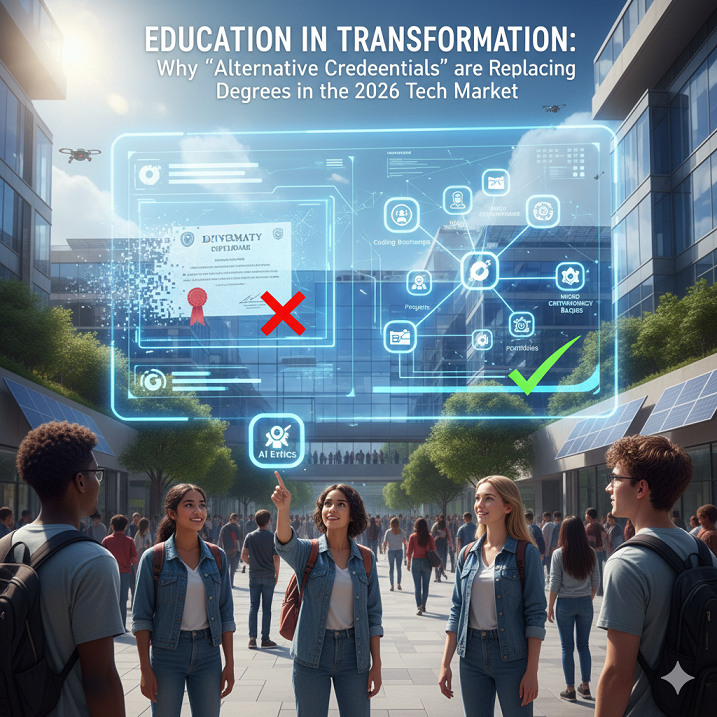
Education in Transformation: Why “Alternative Credentials” are Replacing Degrees in the 2026 Tech Market
By the year 2026, the labor market for technology is going through a major shift, with alternative credentials gradually replacing conventional college degrees as the key measure of employability. Formal academic credentials are being replaced by practical skills, validated knowledge, and demonstrated project experience as the most important factors for employers to consider. The acquisition of specific knowledge in fields such as artificial intelligence (AI), cloud computing, cybersecurity, and data analytics is made possible for applicants via the use of micro-credentials, digital badges, bootcamps, and professional certifications. Learners are able to tailor their education to meet the requirements of the market since these credentials are often modular, stackable, and verified via tests, projects, or business collaborations. The agility, hands-on experience, and proven skill sets that alternative credentials give are highly valued by businesses. These credentials enable an organization to quickly onboard new employees and reduce the gap between education and employment rates. Additionally, in comparison to conventional degree programs, these programs are more easily accessible, less expensive, and more efficient with regard to time, which makes them attractive to a broad workforce all over the world. Alternative certifications also place an emphasis on lifelong learning, which requires professionals to continually update their abilities in order to maintain their competitive edge. This pattern is indicative of a paradigm shift toward competency-based recruiting procedures, in which results and practical expertise are prioritized above the reputation of the institution. Within the context of the 2026 technology ecosystem, the perception of education and professional certification is being reshaped as a result of the fast evolution of technology, which is driving the need for talented and adaptable personnel.
Increasing Numbers of Micro-Credentials
Micro-credentials are a kind of acknowledgment that is intended to be succinct and focused on certain abilities and competences. These degrees, in contrast to standard degrees, provide students the opportunity to rapidly build competence in certain fields. Numerous practical examinations or projects that demonstrate the learner’s capabilities are often associated with each and every certificate. These certifications are becoming more important to employers as markers of preparation, skill mastery, and flexibility. Additionally, micro-credentials facilitate continual learning, which enables professionals to upgrade their abilities in accordance with the evolving norms of their sector. In sectors that are constantly evolving, such as artificial intelligence, cloud computing, and cybersecurity, their adaptability and specialization make them extremely important.
There are also intensive training programs and bootcamps.
Due to the fact that they emphasize hands-on learning and project-based learning, intense technology programs and bootcamps have become more popular. These programs compress the training that would normally take months into a matter of weeks, with an emphasis on practical applications rather than academic understanding. The participants take part in group projects, simulations, and capstone experiences that are designed to simulate the issues they would face in the workplace. Individuals that graduate from these schools are highly valued by employers due to their ability to solve problems and their rapid application. In addition, bootcamps improve employability by providing chances for networking, coaching, and exposure to the most recent technologies and platforms used in the field. This is accomplished without the lengthy time commitment required for conventional degrees.
Certified Professionals and Digital Badges in the Industry
Verifiable evidence of knowledge is provided by digital badges and certificates, which are often sponsored by reputable organizations or technology vendors. As a result of their ease of dissemination throughout professional networks, they provide an air of trustworthiness to the profile of a candidate. It is possible to bridge the gap between study and job by obtaining certifications, which indicate expertise in a variety of tools, programming languages, frameworks, and specialized fields. The current trend toward skills-based recruiting is reflected in the fact that many technology organizations have begun to include these qualifications into their hiring criteria. The personnel are able to follow modular learning pathways that are matched with their professional objectives thanks to this strategy.
Recruiting Based on Competencies
Twenty-six years from now, competency-based recruiting will be the norm in the field of technology recruitment. Instead than focusing just on degree qualifications, employers place more importance on practical performance, portfolio proof, and applied abilities of candidates. It is becoming more common for interview procedures to include coding challenges, problem-solving exercises, and project evaluations in order to verify skills. This strategy guarantees that applicants are capable of doing jobs efficiently from the very first day, hence decreasing the amount of time spent on training and enhancing efficiencies. Alternative credentials are a perfect match inside competency-based frameworks, which gives employers the ability to evaluate verifiable talents in a manner that is both fast and fair.
Availability of Access and Inclusion of the Global Workforce
Through the reduction of financial, geographical, and temporal obstacles, alternative credentials make it easier for more people to enter the field of technology. Learners from a wide range of backgrounds are able to gain skills that are in high demand because to the availability of inexpensive courses, flexible scheduling, and remote learning platforms. Because of this inclusion, the talent pool is expanded, and businesses are able to recruit people from all over the world without having to need formal degree programs. In order to increase diversity and decrease dependency on conventional academic institutions, workers who have taken nontraditional pathways may show their capabilities by presenting portfolio projects and credentials that have been established and confirmed.
Adaptability and Learning That Lasts a Lifetime
The rapid advancement of technology necessitates continual skill improvement, and alternative credentials provide support for learning that continues throughout one’s life. Professionals have the ability to easily upskill, reskill, or pivot to other jobs, which allows them to retain their competitiveness in the ever evolving technology industry. Learners are able to gain complete competence without committing to long degree programs by having the opportunity to stack certificates during the course of their education via modular programs. When flexibility is emphasized, it guarantees that personnel continue to be relevant and are able to handle the ever-changing technologies, platforms, and procedures that are prevalent in their respective sectors.
The Relevance of the Curriculum and Partnerships with Employers
In order to guarantee that their curriculums are in line with the requirements of the current market, most alternative certification programs work directly with technology businesses. Training may be better aligned with real-world applications, new technology, and practical difficulties when this is accomplished via industry collaborations. Employers may choose to subsidize educational programs, provide mentoring opportunities, or include project assessments into certification processes. This synergy guarantees that the outputs of learning are in line with the goals of the company, therefore producing a workforce that is equipped with skills that can be promptly put into action. The legitimacy and worth of alternative credentials are both increased as a result of such alignment.
Alterations in the Way Degrees Are Regarded
The view of the importance of conventional degrees is altering in the technology sector, despite the fact that traditional degrees continue to convey status. Degrees are being widely recognized by businesses as not being sufficient to ensure skill competency or flexibility. The openness, clarity, and demonstration of practical skill that alternative credentials provide are the reasons why they are widely respected. Degrees are seen as supplemental rather than required, especially in industries that are constantly evolving, such as artificial intelligence (AI), software development, and cloud computing. This is because more and more companies are adopting a skills-based recruiting approach.
The Prospects for the Education of Technology
The move toward alternative certifications in 2026 is indicative of a long-term change in the teaching and recruiting procedures that are now in place. It is possible for traditional colleges to adapt by providing competency-based programs that are modular in nature, including industry-aligned certifications, and placing an emphasis on experiential learning environments. The workforce will continue to place a higher value on qualifications that can be shown, portfolios, and documented accomplishments than it does on institutional affiliation. The cultivation, evaluation, and employment of talent are all reshaped as a result of this change, which results in the creation of a technology ecosystem that is more adaptable, responsive, and inclusive for the next decades.